Prepare for the FAA Instrument Rating Written Exam
Instrument procedures, navigation systems, weather theory, and IFR regulations — all covered with AI-powered explanations and adaptive study tools aligned to the FAA Airman Certification Standards.
7-day free trial. No credit card required. Full access to all IFR content.
What is the FAA Instrument Rating Knowledge Test?
The Instrument Rating Knowledge Test is the written exam required before you can earn your Instrument Rating — the qualification that allows you to fly in instrument meteorological conditions (IMC), including clouds, low visibility, and controlled airspace under IFR flight rules.
The exam covers 7 knowledge areas defined by the FAA Airman Certification Standards (ACS), focusing on instrument flight procedures, navigation systems, weather analysis, and IFR regulations. You'll have 120 minutes to answer 60 multiple-choice questions, and you need a score of 70% or higher to pass.
The IFR written exam is widely considered more challenging than the PPL test — not because of the format, but because the material is more technical. Topics include interpreting approach plates, understanding navigation systems (VOR, GPS, ILS), analyzing complex weather phenomena, and applying intricate regulatory requirements. A solid study plan with quality practice questions makes a significant difference.
All 7 ACS Knowledge Areas — Fully Covered
Every topic tested on the Instrument Rating Knowledge Test, organized by the FAA Airman Certification Standards.
Preflight Preparation
Pilot qualifications, weather information for IFR flight, cross-country flight planning, instrument/equipment requirements
Preflight Procedures
Instrument cockpit check, IFR flight plan filing, departure procedures
ATC Clearances & Procedures
ATC clearance interpretation, compliance, holding procedures, IFR communications
Flight by Reference to Instruments
Instrument scan techniques, attitude instrument flying, unusual attitude recovery
Navigation Systems
VOR, GPS, DME, ADF navigation; RNP and RNAV concepts; system limitations and errors
Instrument Approach Procedures
Precision approaches (ILS, GLS), non-precision approaches (VOR, GPS, NDB), circling, missed approach procedures
Emergency Operations
Partial panel operations, lost communications (91.185), system failures, emergency approaches
How AviaSkill Helps You Pass
The same six powerful study tools, tailored for Instrument Rating preparation.
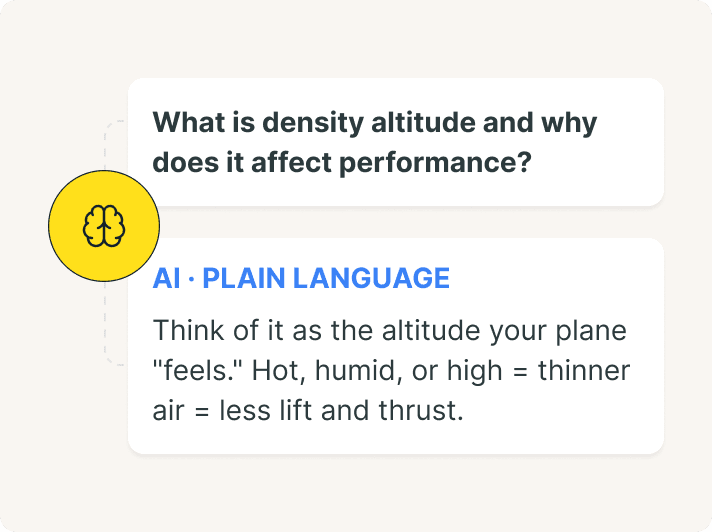
AI Explanations
Detailed breakdowns of approach procedures, navigation concepts, and weather theory — with direct links to relevant AIM and PHAK sections
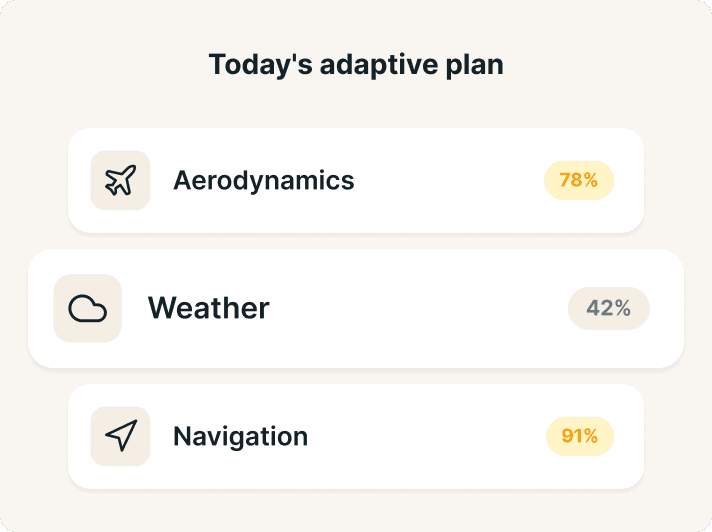
Smart Study
Focus on your weakest IFR topics — navigation systems, approach procedures, or weather — with AI-optimized sessions
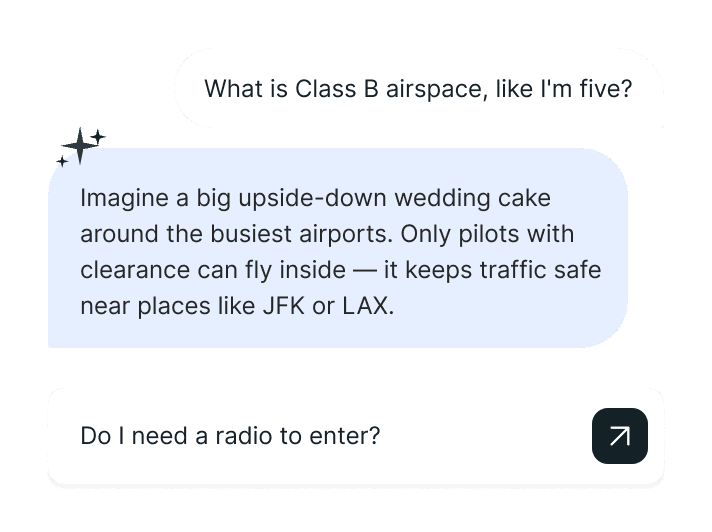
AI Tutor
"Walk me through an ILS approach." "What's the difference between LNAV and LPV?" Get instant, detailed answers 24/7
Backed by FAA Handbooks
Powered by official FAA publications — so every answer is one you can trust.
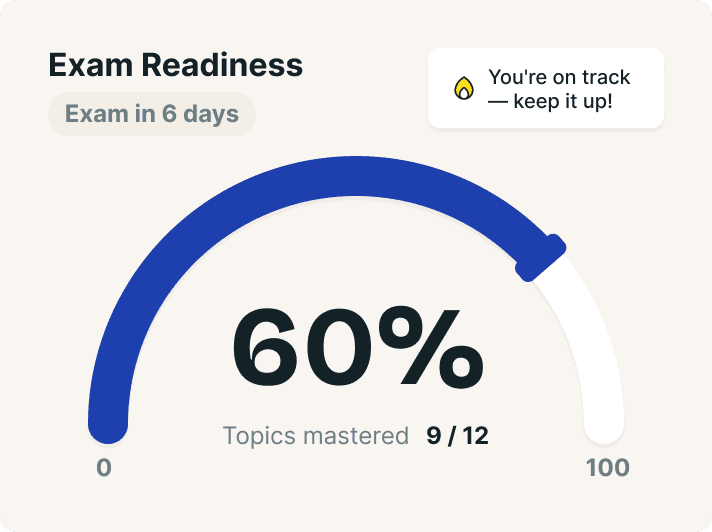
Progress & Readiness
Track mastery across all 7 IFR knowledge areas — see exactly where you need more work before test day
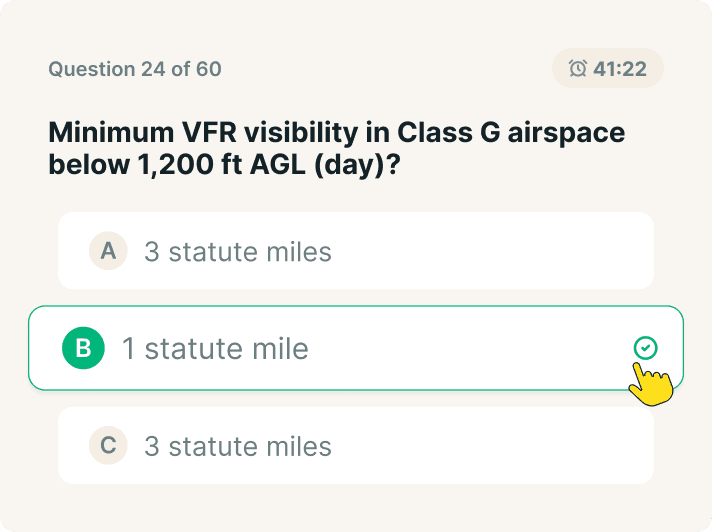
Exam Simulator
Take full-length 60-question practice exams with a 120-minute timer — matching the real IFR exam format
Know What to Expect on Test Day
| Official Name | Instrument Rating — Airplane (IRA) Knowledge Test |
| Test Code | IRA |
| Questions | 60 multiple-choice (select one from three options) |
| Time Limit | 120 minutes (2 hours) |
| Passing Score | 70% (42 correct out of 60) |
| Calculator | Provided (or approved personal calculator) |
| Reference Materials | FAA-approved test supplement provided (includes approach plates, weather charts, navigation charts) |
| Retake Policy | No mandatory waiting period — requires additional training and a new instructor endorsement (14 CFR 61.49) |
| Test Validity | 24 calendar months (2 years) per 14 CFR 61.39 |
The IFR knowledge test is administered at the same FAA-authorized testing centers as the PPL exam (PSI or CATS). You'll need an instrument ground instructor or CFII endorsement to schedule. The test supplement includes real approach plates and weather charts — practicing with these materials is essential for exam success.
Study Tip: The IFR exam includes questions that require reading and interpreting approach plates, weather depictions, and instrument charts from the provided test supplement. AviaSkill's practice questions include the same types of chart-based and scenario-based questions you'll see on the real exam.
Your Path to the Instrument Rating
Prerequisites
- A Private Pilot Certificate (or be concurrently training for one)
- An endorsement from a CFII or instrument ground instructor
- 50 hours of cross-country PIC time (14 CFR 61.65)
- 40 hours of actual or simulated instrument time
Earn Your Private Pilot Certificate
Complete PPL training and pass both the knowledge test and checkride. Already have your PPL? You're ready for step 2.
Begin Instrument Training
Find a CFII (Certified Flight Instructor — Instrument) and start logging instrument flight hours. You'll need at least 40 hours of actual or simulated instrument time.
Complete Instrument Ground School
Study instrument procedures, navigation systems, weather theory, and IFR regulations. AviaSkill accelerates this preparation with AI-powered practice.
Pass the Knowledge Test
Take the FAA Instrument Rating Knowledge Test at a testing center. 60 questions, 120 minutes, 70% to pass.
AviaSkill Helps HerePass the Instrument Checkride
Demonstrate instrument flight proficiency to a DPE — including approaches, holding patterns, unusual attitudes, and emergency procedures.
Earn Your Instrument Rating
You're now qualified to fly in instrument meteorological conditions. A critical step toward professional aviation careers.
Continue Your Aviation Journey
The Instrument Rating opens doors to advanced certifications and professional aviation.
Commercial Pilot (CPL)
Get paid to fly. Requires PPL, IFR (for airplane), and at least 250 hours total time.
Coming soonFlight Instructor (CFI)
Teach others to fly and build flight hours. Many pilots earn their CFI while working toward ATP minimums.
Coming soonCFII (Instrument Instructor)
Teach instrument flying. Requires CFI certificate plus additional instrument training.
Coming soonATP & Beyond
Airline Transport Pilot — the highest level of pilot certification. Required for airline operations.
Coming soonThe Instrument Rating is considered the most valuable single rating a pilot can add after the PPL. It's required for most professional aviation careers, improves safety in all weather conditions, and is a prerequisite for the Commercial Pilot Certificate (airplane category).
Tools pilots actually use
Crosswind, METAR, weight & balance — always free, no sign-up needed.
Ready to Pass Your Instrument Rating Written Exam?
Master instrument procedures, navigation systems, and weather theory with AI-powered study tools. All 7 ACS knowledge areas covered. 7-day free trial — no credit card required.